Zen rock garden with centuries-old moss, Kyoto
Kyoto served as Japan's imperial capital for over a millennium, from 794 to 1869, and its gardens are the direct expression of that extraordinary cultural continuity. Monks, aristocrats, shoguns, and artists — each era left its imprint in rock, water, and plant, producing a garden tradition of breathtaking diversity and depth.
The gardens of Kyoto span every major school of Japanese landscape design: the sweeping stroll gardens (kaiyushiki-teien) of the Edo aristocracy, the meditative dry rock gardens (karesansui) of Rinzai Zen Buddhism, and the intimate moss gardens that seem to exist outside of time. No other city in the world concentrates such garden art in so small an area.
This guide covers eight of the finest gardens — from the world-famous Ryoan-ji to the intimate spaces that remain blessedly under-visited. Each has its own character, its own best season, and its own way of slowing the visitor into something like stillness.
Each of these gardens rewards a different pace of visiting. Some demand contemplative stillness; others invite a two-hour stroll. All deserve your full, unhurried attention.
The most celebrated garden in Japan, and possibly the most debated. Ryoan-ji's karesansui — a precisely raked rectangular field of gravel, 25 by 10 metres, containing fifteen stones arranged in five groups — has provoked philosophical inquiry for five centuries. The original designer remains unknown; the intent, never officially stated.
Seen from the wooden veranda of the hojo (abbot's hall), the stones appear to float. A peculiarity noted by Zen scholars: no matter where the viewer sits along the veranda, exactly fourteen stones are visible at any one time. Only by levitating above the garden can all fifteen be seen at once — a deliberate invitation to transcend ordinary perception.
Beyond the rock garden, Ryoan-ji's grounds include Kyoyochi Pond — a large strolling garden built in the Heian period (794–1185) predating the famous rock garden by centuries. Its reflection of the surrounding forest in early morning is extraordinary.
The Moss Temple — as Saihoji is universally known — is unlike any garden you will encounter elsewhere. Over 120 varieties of moss carpet every surface: stone lanterns disappear into emerald cushions, paths become rivers of living green, and the light filtering through the temple's cryptomeria trees gives everything a subaqueous quality. The effect is profoundly calming and entirely unlike any other garden experience.
Access requires advance reservation via the temple's official postcard or online application system. A nominal fee of ¥3,000 covers the meditative sutra-copying ceremony that precedes entry into the garden — a meaningful way to prepare the mind. Numbers are strictly limited; spaces release several months in advance and fill rapidly during peak seasons.
The stroll garden follows a figure-of-eight path around the upper and lower sections, culminating in a rock garden at the hilltop that dates from the garden's original 14th-century design by the monk Muso Soseki.
Within the sprawling Daitoku-ji temple complex — a city within a city of 24 sub-temples in northern Kyoto — Shinjuan is the most intimate and the most Zen. The sub-temple was founded in the 16th century by the renowned tea master Ikkyu Sojun, and the garden retains his spare aesthetic sensibility. Two karesansui gardens frame the main hall, one featuring a carefully arranged group of stone groupings set in raked white gravel, the other more playful and informal.
Daitoku-ji as a whole rewards extended exploration. The Daisen-in sub-temple garden — another masterpiece of miniature landscape — depicts the passage of a river from mountain source to open sea entirely in rocks and gravel, within a space barely 12 metres long. The Koto-in sub-temple is particularly famous for its autumn maples.
Entoku-in is one of Kyoto's best-kept garden secrets. Situated on the slopes of Higashiyama, behind the more famous Kodai-ji Temple, it receives a fraction of the crowds that queue at nearby Ryoan-ji while offering karesansui of comparable quality and historical interest.
The garden was created for Nene — the widow of the warlord Toyotomi Hideyoshi — using stones transplanted from the garden of Fushimi Castle after Hideyoshi's death in 1598. The north garden features large natural stones arranged with unusual dynamism; the south garden, viewed from within the shoin reception hall, is more conventional in its refined balance. The temple also houses the celebrated Kaigetsudo fusuma paintings and offers matcha in the tea room overlooking the garden.
The Ninomaru Garden within Nijo Castle was designed by the tea master and garden designer Kobori Enshu in the early 17th century for the third Tokugawa shogun, Iemitsu. Unlike the contemplative gardens of Zen temples, the Ninomaru was explicitly designed to impress — to project the power and elegance of the Tokugawa shogunate to visiting feudal lords.
The stroll garden centres on a large pond with three islands connected by stone bridges. The arrangement of stones around the pond is particularly fine — massive, rough-cut boulders are placed with great deliberation to suggest both mountain scenery and the solidity of Tokugawa rule. Cherry trees planted along the paths bloom spectacularly in spring; seasonal cherry blossom illumination events are held in the castle grounds each year.
The inner garden of Heian Shrine — entirely separate from the famous vermilion-gated precinct — is one of Kyoto's grandest stroll gardens and one of its least crowded. Designed in the Meiji period (1895) to evoke Heian-period aristocratic garden culture, it wraps around the rear of the shrine in four distinct sections traversed by a continuous path.
Each section has its signature moment: the east garden's weeping cherries in April, the central garden's irises in June (over 200 varieties fringing the broad central pond), the west garden's water lily pond in July and August, and the covered wooden bridge that runs across the largest pond in the northern garden. The bridge is a particularly fine piece of garden architecture — its reflection doubling the columns in the still water.
Ginkaku-ji — the Temple of the Silver Pavilion — is a UNESCO World Heritage site at the northern end of the Philosopher's Path in Higashiyama. Despite its name, the pavilion was never actually coated in silver: the project was abandoned on the death of shogun Ashikaga Yoshimasa in 1490. In a characteristically Japanese inversion, the absence of silver has become a virtue, and the weathered, unpainted wood is now considered an expression of wabi-sabi aesthetics.
The garden is composed of three distinct elements, each exceptional. The flat sand garden (kogetsudai) features a large conical mound of white sand — the "Moon-Viewing Platform" — whose function remains debated. The lower moss garden surrounds a serene central pond with moss-clad stones and azaleas. A path climbs the hill behind the pavilion to a viewpoint offering a panorama of Kyoto that Yoshimasa himself would have surveyed.
The Philosopher's Path (Tetsugaku-no-michi) is not a garden in the strict sense, but it is one of Kyoto's most considered landscapes: a 2 km walking route along a canal-side path between Ginkaku-ji to the north and Nanzen-ji to the south. The path takes its name from the philosopher Nishida Kitaro, who walked it daily in contemplation — and it is easy to understand why.
The path is lined with hundreds of cherry trees whose branches form a tunnel overhead in late March and early April, the canal below carrying the fallen petals southward. Outside of cherry blossom season it is quieter and, arguably, more beautiful — autumn maples, winter camellia, and the constant, unhurried sound of water beneath the stone bridges. Small temples, galleries, and coffee shops are interspersed along the route.
The recommended direction is south to north: starting at Nanzen-ji, climbing to Ginkaku-ji, and finishing with a descent to the city by bus from Ginkakuji-michi stop.
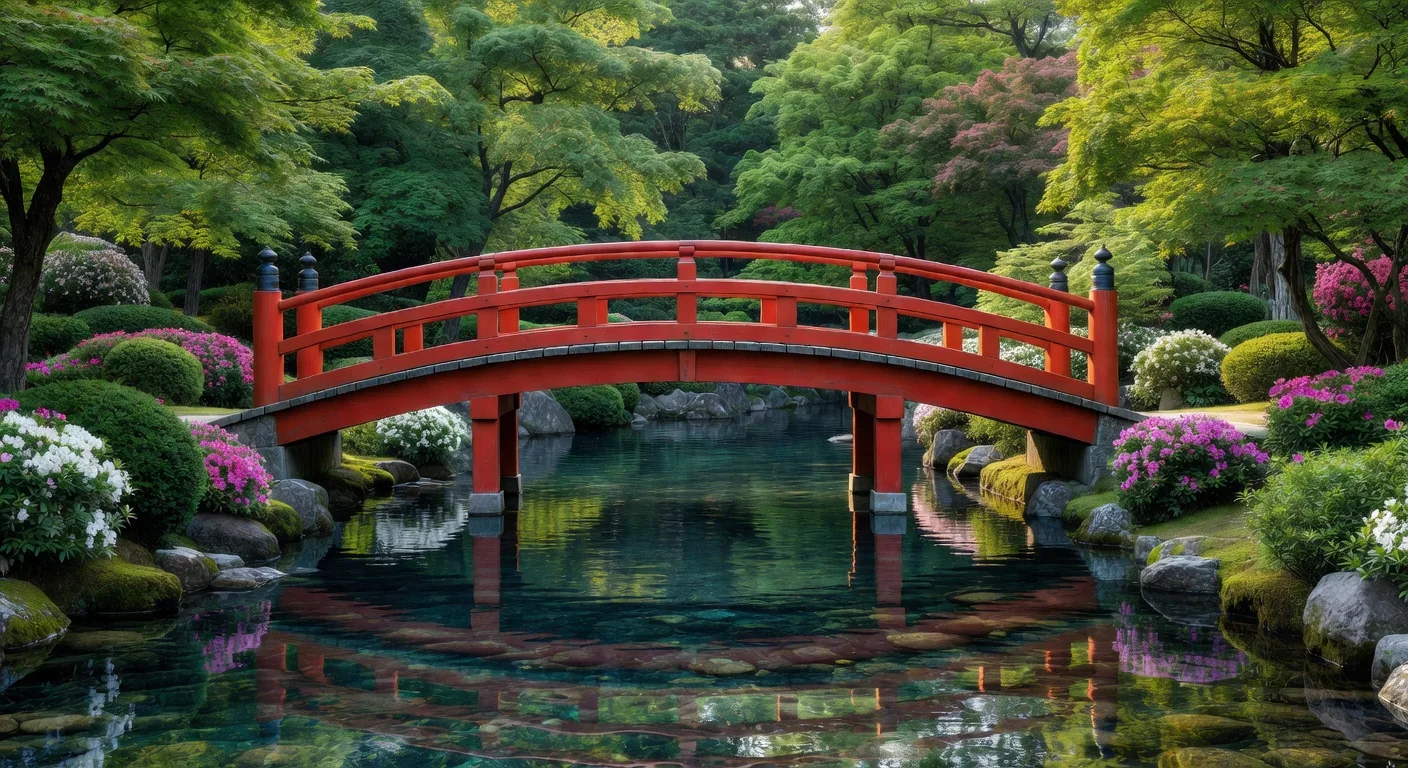
Water is the lifeblood of the Japanese garden. In Kyoto, where the surrounding mountains feed clear streams year-round, garden designers have worked for centuries with this abundance — shaping ponds, directing streams, and placing bridges to articulate movement through the landscape.
Japanese garden bridges (hashi) range from single stepping stones laid across a narrow stream to elaborate covered wooden structures spanning major ponds. Kyoto's gardens contain examples of every type:
The sori-bashi — the high-arched vermilion bridge seen at Heian Shrine and Itsukushima-inspired compositions — is the most dramatic form. Its reflection in still water creates a perfect oval, transforming a functional crossing into a visual centrepiece. The arch is deliberately too steep for comfortable walking; the slowness it imposes is intentional, encouraging the visitor to pause at the apex and survey the garden from a privileged height.
Flat stone bridges (ishi-bashi), cut from single slabs of granite, speak a different language — weight, permanence, geological time. Koishikawa Korakuen and Sanzen-in both feature stone bridges of exceptional age and beauty.
The technique of shakkei — incorporating distant landscape into the garden composition as a "borrowed" backdrop — reaches its finest expression in Kyoto. Entsu-ji, north of the city, frames the forested hillside of Mt. Hiei directly behind its karesansui garden with a precision that collapses the boundary between the designed space and the mountain. Isuien in Nara similarly borrows the roof of Todai-ji as a feature of its composition.
The majority of Kyoto's temple gardens require no advance booking — you simply arrive, pay at the gate, and enter. The key exception is Kokedera (Saihoji Temple), which has operated a strict reservation system since 1977 to protect the moss gardens from overuse.
To visit Kokedera, applications must be submitted via postcard (addressed to the temple) or through the temple's online reservation system at least two weeks in advance. The temple will confirm by return post or email. Applications from overseas are accepted; write the reply address clearly. The entry fee of ¥3,000 is payable on arrival and includes a sutra-copying session prior to garden entry.
During cherry blossom season (late March–early April) and autumn foliage season (mid-November), the most famous gardens — Ryoan-ji, Ginkaku-ji, and Kinkaku-ji — can see queues of 45 minutes or more. Arrive before 8 am (most gardens open at 8 or 8:30), visit popular gardens on weekdays, and consider less-known alternatives such as Entoku-in or Shinjuan for a more contemplative experience.
| Garden | Entry Fee | Best Season |
|---|---|---|
| Ryoan-ji | ¥600 | All year / Winter |
| Kokedera | ¥3,000 | June / Autumn |
| Shinjuan / Daitoku-ji | Varies | Autumn |
| Entoku-in | ¥500 | Autumn (illumination) |
| Nijo Castle | ¥800 | Spring / Year-round |
| Heian Shrine Garden | ¥600 | June (iris) |
| Ginkaku-ji | ¥500 | Autumn / Winter |
| Philosopher's Path | Free | Spring / Autumn |
The eastern mountain district of Kyoto — Higashiyama-ku — concentrates an exceptional density of temple gardens within a compact, walkable area. This half-day walking route connects six major sites from north to south, all linked by a continuous network of stone-paved lanes.
Start at the north. Arrive early (8 am opening) to see the silver pavilion and sand cone before the crowds arrive. Allow 45 minutes.
Walk south along the canal-side path. Stop at the small Honen-in temple (free, extraordinary atmosphere) halfway along. Allow 30–45 min walking time.
The Nanzen-ji sub-temple Konchi-in contains an important Kobori Enshu garden. The main temple has a grand Sanmon gate. Allow 30–45 minutes.
A short walk west through Okazaki. The inner garden is best from the west entrance. Allow 1 hour to fully traverse all four sections.
Continue south along Nene-no-michi lane. Entoku-in is immediately behind Kodai-ji. Allow 30–40 minutes including tea in the garden tea room.
End at the stone-paved Ninenzaka and Sannenzaka lanes established up to Kiyomizudera Temple. The approach itself is a heritage preservation district of extraordinary character. Return to central Kyoto by bus from Kiyomizumichi stop.
Kyoto's temples and gardens are living religious and cultural sites — simultaneously sacred spaces, working monasteries, and public heritage sites. Photography is generally permitted in outdoor areas, with the following important nuances:
Photography inside main halls, shrines, and buildings is almost universally prohibited. Look for 撮影禁止 signs and follow all posted restrictions without exception.
If monks or worshippers are present in a garden space, exercise discretion. Avoid photographing individuals at prayer without their knowledge or consent.
Selfie sticks are prohibited at most Kyoto temple gardens. They pose a risk to other visitors on narrow paths and to wooden structures. A small tripod (where permitted) is a better alternative.
The famous viewpoints — Ryoan-ji's raked gravel viewed from the veranda, Ginkaku-ji's sand cone — are shared by all visitors. Take your photographs, then move along to allow others their moment.
Drone photography is strictly prohibited at all Kyoto temple gardens and UNESCO heritage sites. Violations carry significant fines and may result in legal action.
Overcast days produce the most even, atmospheric light in Japanese gardens. Rain is perhaps the finest condition of all — moss gardens especially come alive in wet weather, and the garden appears as its designers intended: damp, still, and alive.