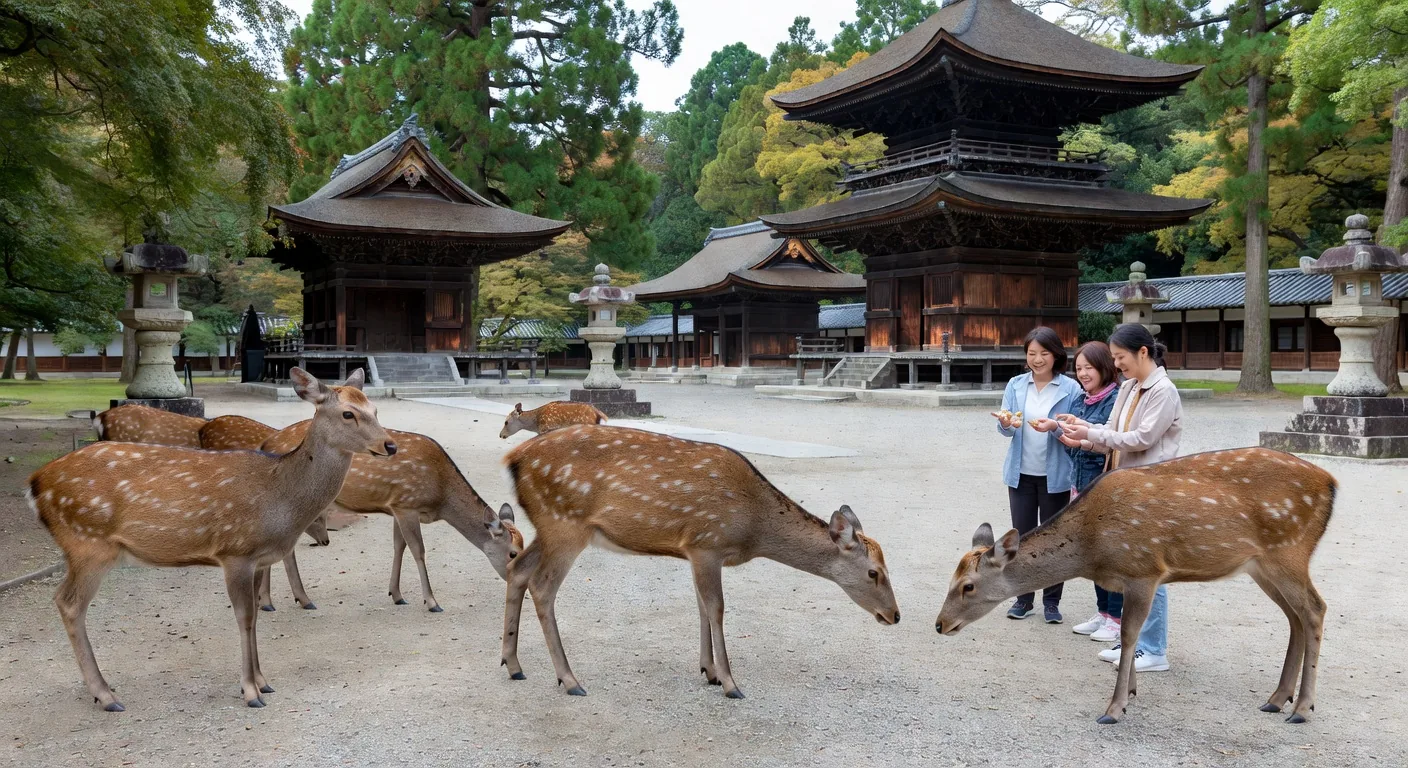
Nara Park (奈良公園, Nara Kōen) was established in 1880 on the eastern edge of Nara city, built around the ancient temples and shrines that had already occupied this landscape for over a thousand years. Its 502 hectares spread across undulating wooded hillsides, open meadows, and formal gardens, encompassing four UNESCO World Heritage monuments within or immediately adjacent to its boundaries.
Nara was Japan's first permanent capital (710–784 AD), and the park occupies ground saturated with national significance. The ancient Nara temples — built during the city's brief but culturally explosive period as the imperial seat — remain in extraordinary condition: Todai-ji, Kofuku-ji, and Kasuga Grand Shrine still function as active religious institutions within the park, their rhythms of ceremony and season unchanged for centuries.
The park's most immediately remarkable feature, however, is its permanent population of freely roaming Sika deer — approximately 1,300 animals who wander every path, plaza, and open space with complete indifference to the human visitors around them. These deer are not tame, and they are not a zoo exhibit. They are, in the deepest sense, residents.
The deer of Nara Park (shika, 鹿) are designated a National Natural Treasure of Japan. They are Sika deer (Cervus nippon), a species native to East Asia, and they have roamed the park grounds continuously for at least 1,300 years. According to Shinto tradition, when the god Takemikazuchi-no-mikoto descended to earth to help establish the Kasuga Shrine, he arrived riding a white deer — and from that day, the deer of Nara became the sacred messengers (shinroku, 神鹿) of the gods.
Killing a Nara deer was a capital offence until 1637. When an American GI accidentally killed one with his car in 1945, it was reported in national newspapers as a significant cultural incident. The deer are protected under Japanese law to this day, and their welfare is monitored by the Nara Deer Preservation Foundation.
The most direct way to connect with the deer is through shika senbei — flat, round rice crackers sold throughout the park by vendors in traditional stalls for approximately ¥200 per bundle. The crackers are made from rice bran and wheat flour; they are nutritionally appropriate for the deer and taste, if you're curious, like a mild, slightly grainy rice wafer.
The deer have learned — or more accurately, they have taught humans — a specific interaction ritual. If you bow to a deer while holding a cracker, many individuals will bow back before receiving the treat. This is not coincidence: it is a genuine learned behaviour passed through the population, and it is one of the most quietly astonishing things you will encounter in Japan.
Hold the cracker flat in an open palm, not between your fingers. Deer have no upper front teeth but their lower teeth and determination are sufficient to nip if fingers are in the way. Keep the crackers in a bag until you're ready — deer that see the packet will demand it immediately and persistently.
Deer are wild animals. Bucks (male deer) are occasionally aggressive, particularly in rutting season (September–November). If a deer approaches with its head down and ears laid back, move away calmly without running. Do not push or kick — simply put distance between yourself and the animal. Most aggressive encounters arise from visitors teasing deer or hiding crackers.
Deer will eat paper, plastic bags, maps, and anything resembling food packaging. Secure your belongings. Deer have been known to investigate jacket pockets, pull scarves, and chew corners of unattended backpacks. This is charming the first time and less charming when it's your train ticket.
Only shika senbei should be fed to the deer. Human food — particularly sweets, salty snacks, and processed foods — is harmful to the deer and illegal to offer within the park. Do not feed deer leaves or branches either, as some ornamental plants within the park grounds are toxic to them.
For photographs, dawn and dusk are magical: the light is golden and the deer are most active. The area near Ukimido Pavilion at sunrise is particularly atmospheric, with deer grazing in the mist beside the pond. Avoid using flash near deer — it startles them and is disrespectful to the animals.
Male deer carry antlers from spring through autumn. During the Deer Antler Cutting Ceremony (shika no tsunokiri) in October, the bucks' antlers are trimmed by traditional deer handlers — a spectacle held over three days at Kasuga Grand Shrine. Outside this period, be mindful that antlers pose a risk if a buck raises its head unexpectedly near children. Hinds (does) are generally gentler year-round.
Within and immediately adjacent to Nara Park, six extraordinary cultural and natural sites reward the visitor with some of Japan's finest architecture, garden design, and historic landscape.
The Daibutsuden (Great Buddha Hall) of Todai-ji is the largest wooden building on earth — a fact all the more extraordinary given that it is only two-thirds the size of the original 8th-century structure. The hall houses the Daibutsu (Great Buddha): a 15-metre bronze statue of Vairocana Buddha, cast in 752 AD and continuously maintained ever since.
Approach the Daibutsuden through the Nandaimon Gate — an imposing 8th-century gate flanked by two extraordinary Nio guardian statues, each 8.4 metres tall and considered among the finest wooden sculptures in Japan. Allow at least one hour inside the hall, and look for the wooden pillar with a hole bored through its base: legend holds that those who can squeeze through will be granted enlightenment. Many try; most fail; all laugh.
Established in 768 AD as the tutelary shrine of the powerful Fujiwara clan, Kasuga Grand Shrine remains one of the most revered Shinto sites in Japan. The approach through Kasugayama primeval forest — following a long path lined with hundreds of mossy stone lanterns — is among the most atmospheric walks in Nara. Over 2,000 bronze lanterns hang inside the shrine precinct; there are more than 3,000 stone lanterns along the approach paths.
The lanterns are lit on just two occasions each year: during the Mantoro Lantern Festival in February and August. On these evenings, the forest path and shrine precinct glow with thousands of simultaneous flames — one of Japan's most hauntingly beautiful seasonal events. On ordinary days, the vermilion galleries and the sound of priests chanting within the inner precinct provide all the atmosphere required.
Isuien is among the most technically accomplished stroll gardens in all of Japan — a two-part composition built across two distinct historical periods and unified by a shared mastery of shakkei (borrowed scenery). From the garden's principal viewpoints, the roof of Todai-ji's Nandaimon Gate and the distant line of the Wakakusa hills are incorporated seamlessly into the garden composition, extending the visual space far beyond the garden's physical boundaries.
The front garden (constructed in the 17th century) is more intimate; the rear garden (added in the Meiji period) is broader, centred on a large central pond surrounded by carefully shaped shrubs, stone lanterns, and tea-ceremony-style structures. The adjacent Neiraku Art Museum is included in the entry fee and displays a fine collection of Chinese and Korean bronzes and ceramics.
Yoshikien, immediately adjacent to Isuien, is Nara's most visitor-friendly garden — and one of its most rewarding. The Nara prefectural government makes admission free for international visitors, recognising the garden's value as a cultural ambassador. Entry for Japanese visitors is ¥250.
The garden contains three distinct styles within its compact grounds: a moss garden of quiet beauty, a tea ceremony garden with two tea houses set around a roji (dewy path), and a pond garden with a small waterfall and classic island composition. The juxtaposition of three garden vocabularies within such a small space makes Yoshikien an ideal introduction to the full range of Japanese garden design. Crowds here are a fraction of those at the more famous sites nearby.
Kofuku-ji's five-story pagoda is one of Japan's most recognisable structures — 50.1 metres of stacked cypress timbers, continuously reconstructed in its current form since 1426, and reflected in Sarusawa Pond at its base. The reflection of the pagoda in the pond at dusk — particularly during cherry blossom season when the branches frame the image — is arguably the single most photographed view in Nara.
The temple was the clan temple of the Fujiwara family and was once one of Japan's most powerful Buddhist institutions, comprising 175 buildings at its height. Much was lost to fire and war; what remains, including the Eastern Golden Hall (Tōkondō), the Treasury building, and the surrounding lawns grazed by deer, is exceptional. The Kofuku-ji National Treasure Hall contains some of the finest Buddhist sculpture in Japan, including the famous Ashura statue — a three-faced, six-armed figure of singular emotional power.
The Ukimido (Floating Viewing Hall) stands on Sagi-ike Pond in the southern portion of Nara Park — a hexagonal wooden pavilion built on stilts above the water, connected to the shore by a narrow wooden bridge. Built in 1916 and reconstructed in 1987, it is one of Nara's most romantic structures.
The pavilion has no specific cultural or religious function; it exists simply for contemplation and beauty. Dawn here is exceptional: mist rises from the water, herons stand motionless in the shallows, and the occasional deer wanders to the water's edge to drink. The pavilion is open to visitors and provides a covered resting place with views across the pond toward the wooded hillside. On calm evenings, the reflection of the pavilion in the still water creates a perfect, symmetrical image that seems to exist outside of ordinary time.
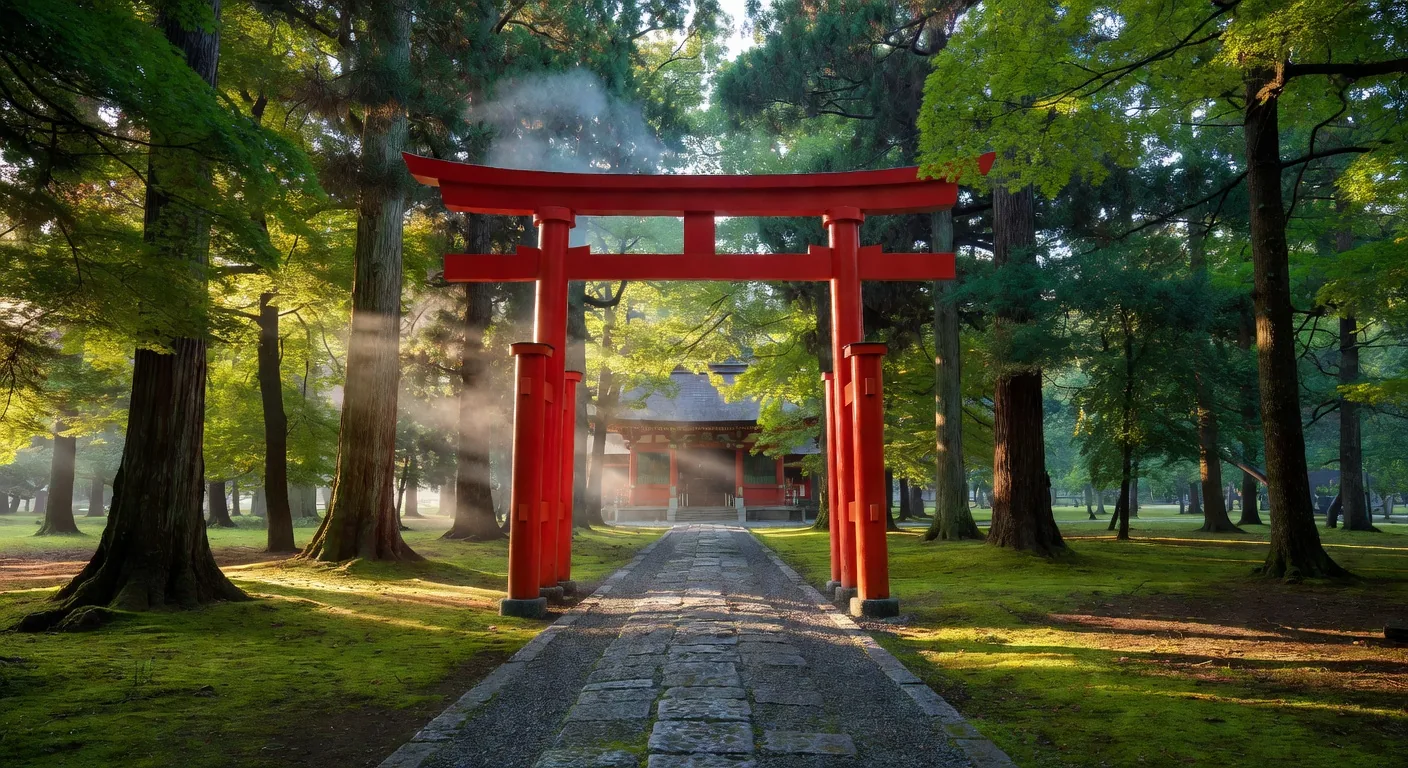
The torii gates of Kasuga Grand Shrine stand as gateways between the human world and the divine — their vermilion lacquer a colour associated in Shinto tradition with vitality, protection from evil, and the passage from the mundane to the sacred. Walking through a torii is an act of ritual purification; visitors traditionally bow before passing beneath the first gate of a shrine precinct.
Kasuga's 3,000 stone lanterns and 2,000 bronze hanging lanterns were donated by worshippers over 1,200 years of continuous religious activity. Each lantern bears the name of its donor; the oldest date to the Nara period (8th century). Most are never lit in ordinary circumstances — their stone is thick with moss, their bronze green with centuries of patina. They exist as a collective prayer in stone and metal, accumulating devotion like sediment.
Twice yearly — during the Mantoro Festival in February (around the 3rd–11th) and August (14th–15th) — every lantern is lit simultaneously. The February festival coincides with Setsubun (the boundary between seasons), when the darkness is complete and cold; the combined light of 5,000 lanterns among the primeval forest trees is one of Japan's most extraordinary spectacles. Crowds are manageable for the February festival; the August festival draws larger numbers due to the summer tourist season.
Immediately behind the shrine, the Kasugayama hill has been protected as sacred forest for over 1,250 years — an unbroken record of non-intervention that makes it one of Japan's last genuine primeval forest fragments. The 250-hectare forest is a UNESCO World Heritage Site and is accessible via a designated forest path (Kasugayama Forest Road) that winds 3 km through old-growth cedar, Japanese oak, and Japanese cypress. No hunting, logging, or disturbance has been permitted since the shrine's founding — the forest is a living record of what much of central Japan once looked like.
Nara is ideally positioned for visitors staying in either Osaka or Kyoto, with frequent and comfortable train connections from both cities. The park itself is a 15-minute walk east from Nara Station or a short loop bus ride.
| From | Service | Journey Time | Fare | Frequency |
|---|---|---|---|---|
| Osaka (Namba) | Kintetsu Nara Line — Limited Express | 35 min | ¥800 | Every 30 min |
| Osaka (Namba) | Kintetsu Nara Line — Express | 42 min | ¥570 | Every 20 min |
| Osaka (Tennoji) | JR Yamato-ji Line (Rapid) | 45 min | ¥470 | Every 15–20 min |
| Kyoto | JR Nara Line (Rapid Miyakoji) | 45 min | ¥720 | Every 30 min |
| Kyoto | Kintetsu Kyoto Line — Limited Express | 35 min | ¥1,130 | Every 60 min |
| Tokyo | Shinkansen to Kyoto + JR Nara Line | ~3 hrs total | ¥15,000+ | Multiple daily |
Nara Park's ritual calendar extends across the full year, with major festivals drawing both Japanese and international visitors. These events are not tourist performances — they are living religious observances that have continued for centuries.
All 3,000 stone lanterns and 2,000 bronze lanterns at Kasuga Grand Shrine are lit simultaneously at dusk. One of Japan's most spiritually affecting events — the forest glows with 5,000 points of flame. Entry to the inner precinct is included with the standard shrine ticket. Arrive before dusk to secure a viewpoint; the festival runs for approximately 2 hours after sunset.
One of Japan's oldest continuous rituals, performed at Todai-ji's Nigatsu-do Hall every night from March 1–14, culminating in the dramatic Otaimatsu torch ceremony on the night of the 12th. Monks carry enormous burning torches along the open gallery of the hall, scattering sparks across the crowd below. Catching a spark is considered a blessing. The ritual has been performed every year without interruption since 752 AD.
Nara Park's 1,700 cherry trees bloom in late March to mid-April, with the weeping cherries around Kofuku-ji and the rows of Somei-yoshino along the approaches to Todai-ji particularly beautiful. The deer move freely beneath the blossoming trees, indifferent to the season's human significance, which makes Nara's hanami uniquely affecting. The park is illuminated after dark during peak bloom.
The second lantern lighting of the year, coinciding with the Obon festival of the dead. The summer edition draws larger crowds than the February festival; arriving two hours before dusk is advisable. The surrounding forest in midsummer humidity, lit by thousands of lanterns, creates an atmosphere of profound and unusual beauty.
Held at Kasuga Grand Shrine's Roku-en deer enclosure over three October days, this ceremony sees wild bucks separated from the main herd and their antlers ceremonially trimmed by traditional deer handlers (shika-otoko) dressed in white. The trimming prevents injury to both deer and visitors during the autumn rut. It is an extraordinary spectacle of human and animal interaction, drawing large crowds. Tickets (¥1,000) are sold at the venue on the day from 7 am; arrive early as numbers are strictly limited.
Nara Park's autumn colours peak around mid-November, when the park's abundant maple, ginkgo, and Japanese oak trees turn orange, red, and gold. The combination of autumn foliage, stone lanterns, and deer wandering through fallen leaves produces some of the most beautiful natural photography in Japan. Special evening illuminations are held at Kasuga Shrine and within the park grounds during the peak foliage period.
Nara Park is one of Japan's finest destinations for families with children. The freely roaming deer are endlessly engaging, the walking distances are manageable, and the scale of Todai-ji provides genuine awe even for children accustomed to spectacle. A few practical considerations will make the visit safer and more enjoyable for all.
Deer are generally gentle around humans but can startle and bump into small children, particularly when crackers are involved. Children under approximately 7 years old should only feed deer from a supervised adult's hands, not independently. Toddlers should be held when near groups of deer.
Once deer see senbei crackers, they are relentless. Buy the crackers, feed them immediately, then remove the packaging from sight. Teach children to hold the crackers flat and open-handed — deer recognise the feeding gesture and respond predictably when approached correctly.
The main paths within Nara Park are wide and paved; pushchairs are entirely practical for the Kofuku-ji and Sarusawa Pond area. Todai-ji's approach path is gravel but manageable. Baby carriers are ideal for the Kasugayama forest path and garden areas. Most toilet facilities have baby changing stations.
A full-day itinerary covering all six major sites is ambitious with children under 10. A more realistic plan: Todai-ji (with the pillar hole!) + deer meadow + Sarusawa Pond and Kofuku-ji pagoda view + Yoshikien Garden. This takes 4–5 hours with a lunch break and produces very happy, slightly tired children.
Nara Park in July and August is very hot. Start by 8 am, take cover during 11 am–3 pm, and stay hydrated. Ice cream vendors and cold drinks are available throughout the park. The forested Kasugayama path is significantly cooler than the open meadows.
The deer bow. The pillar hole at Todai-ji. The size of the Daibutsu. The sound of 3,000 stone lanterns on a misty morning path. These are experiences that last a lifetime — Nara is one of the most genuinely affecting places in the world for a child to visit.